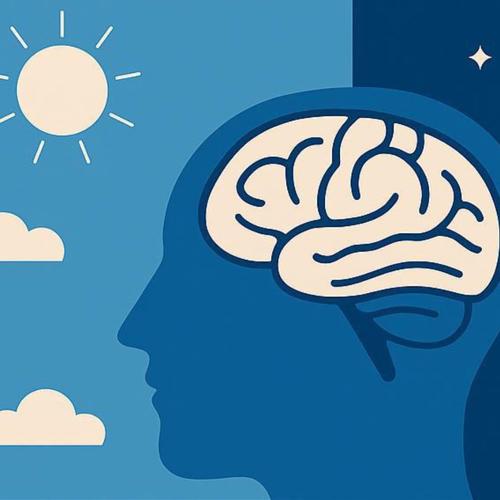
An internal metronome that sets the pace for our performance
Imagine that each of us wears an invisible internal watch, set to our biological rhythm. Like an orchestra conductor, it dictates the tempo of our moments of intense productivity or slowdown. Ignoring this tempo is like playing out of tune: fatigue sets in, cohesion weakens, and performance declines.
The fall time change (a mini jet lag without leaving the country) can remind us how much our mood and efficiency are governed by this finely tuned and sensitive biological clock.
What neuroscience tells us about our biological clock
At the heart of our brain, a small area called the suprachiasmatic nucleus (SCN) acts like a conductor: it coordinates our biological cycles and regulates, among other things, the production of melatonin, which promotes sleep, and influences the production of cortisol, which helps us wake up.
Natural light, especially in the morning, tells our brain that it is daytime. Starting the day in natural light helps our internal clock align sleep and wakefulness with the day-night cycle.
But this cycle is not limited to hormones. The prefrontal cortex, the seat of executive functions (such as decision-making, working memory, and emotion regulation), also follows this tempo. Brain messengers such as dopamine and norepinephrine, which are essential for concentration and motivation, fluctuate according to the phases of this biological cycle.
We are not all programmed the same way
Everyone has a chronotype, which is a personal clock that determines whether we are morning people, evening people, or somewhere in between. This chronotype determines our peaks of energy, attention, memory, and creativity. Aligning tasks with our biological peaks increases productivity, well-being, and collective engagement.
Recent research shows that imposing a morning schedule on someone who is more of a night owl increases the risk of errors, decreased performance, and stress. Several studies (Sandhu et al., Sleep Medicine, 2024; Harrison, Lancet Neurology, 2023) report a temporary increase in cardiovascular accidents, drowsiness, and professional errors in the days following the imposition of such a schedule.
The fall time change: a mini biological jet lag
Setting the clock back an hour in the fall doesn't just give us an extra hour of sleep: it's a mini jet lag that disrupts our internal clock.
For a few days, the brain has to resynchronize: sleep becomes more fragmented, alertness decreases, and concentration fluctuates. The same is true with the time change in summer!
Advice for managers: offering flexibility, encouraging morning exposure to natural light, and lightening the meeting load on the days following the transition may be enough to restore circadian balance.
5 concrete ways to better manage our circadian rhythms
1️. Know your chronotype
Using simple tools such as the Morningness-Eveningness Questionnaire or the Munich Chronotype Questionnaire allows, on a collective level, for a better distribution of rhythms within a team. This data (collected on a voluntary basis) provides a basis for adjusting the planning of each person's tasks.
2️. Adapt schedules and task distribution
Prioritize flexibility: plan demanding tasks for peak cognitive hours (9 a.m. to 11 a.m. for early risers, 2 p.m. to 4 p.m. for late risers). Athletes' teams adjust their training schedules, so why not organizations?
3️. Better manage schedule transitions
Avoid critical meetings right after a schedule change or during circadian lows (often 1 p.m.-3 p.m.). Encourage dynamic lighting and regular breaks to maintain alertness.
4️. Optimize light exposure
Maximize natural light in the morning and reduce exposure to artificial blue light in the evening (phones, screens, neon lights). Some companies are already innovating by integrating light therapy systems into workstations or common areas.
5️. Value diversity of rhythms
Recognize that not being “100% at 8 a.m.” is not a lack of commitment but a biological reality. Respecting these differences promotes mental health, motivation, and collective performance.
Neuroscience and leadership: orchestrate rather than coerce
A high-performing organization is like an orchestra where each musician plays their part. An enlightened manager does not seek to standardize, but to lead: recognizing key moments, combining talents, and creating harmony conducive to collective success.
Taking biological rhythms into account is not a scientific fad: it is an approach at the crossroads of science, leadership, and human capital.
In conclusion
From science to practice, recognizing the existence of these rhythms, optimizing the lighting environment, and adapting schedules paves the way for sustainable performance.
Investing in biological intelligence means investing in true human capital, benefiting individual well-being and collective productivity.
By Roxane Vézina, Eng., ASC, President, Évolutrek Inc.
To learn more:
➡️ Professional Efficiency: Enhancing Your Performance Through Neurosciences
Références
Dijk, D.-J., & Lockley, S. W. (2002). Integration of human sleep-wake regulation and circadian rhythmicity. Journal of Applied Physiology, 92(2), 852–862.
Schmidt, C., Peigneux, P., & Cajochen, C. (2007). Age-related changes in sleep and circadian rhythms: Impact on cognitive performance and safety. Sleep Medicine, 8(6), 558–566.
Harrison, Y. (2023). Circadian misalignment and cognitive performance. Lancet Neurology, 22(7), 612–623.
Sandhu, R. et al. (2024). Impact of daylight saving time transitions on health and performance. Sleep Medicine Reviews, 73, 101890.
Carrier, J. (2025). Chronotypes : quand la biologie dicte l’agenda. Université de Montréal - Institut Douglas.
Scott, A. G. (2023). The Hidden Power of Chronotypes at Work. Harvard Business Review.
Inserm (2024). Chronobiologie : l’influence des rythmes sur le cerveau et la santé.