


An economic environment that stifles innovation
SMEs are the backbone of Quebec's economy: 85% of businesses have fewer than 20 employees and account for 80% of jobs. However, this fragile structure faces major structural challenges.
📉 Key figures for SMEs (2023-2025):
- Payroll costs have increased by more than 18% in two years.
- Insurance costs have jumped by 30%.
- Borrowing costs have skyrocketed by more than 50%.
- In two years, Quebec SMEs have recorded a cumulative financial loss of $11 billion.
Only one-third of businesses are considering expansion. Two-thirds remain reluctant to invest, preferring caution over growth. These figures reveal the decline of a strategic model based on price competition.
The Red Ocean Trap
Faced with these pressures, companies sink into what is known as the Red Ocean: a saturated market where competition is constantly intensifying.
In this context, price becomes the only differentiating factor. Margins shrink, products become interchangeable, and everyone fights to keep their customers rather than create value.
☠ The vicious circle of the Red Ocean:
This mechanism is destructive. Inflation forces companies to reduce their margins. At the same time, customers are looking for the cheapest deals. A price war ensues where no one wins. Worse still, this exhausting dynamic creates a loss of organizational meaning: employees lose sight of the big picture and commitment erodes.
The Blue Ocean Strategy: Create rather than compete
The Blue Ocean Strategy offers a radical solution: instead of competing with rivals in an existing market, create a new market where competition does not exist.
The four strategic levers (ERRC)
To define its Blue Ocean, a company must first identify the fundamental attributes of its sector, then systematically challenge them through four actions:
| 🛑ELIMINATE | Which attributes that have been taken for granted for years can be eliminated without harming value? (Massive cost savings) |
| ⬇ REDUCE | Which attributes can be reduced below industry standards? (Refocusing on the essentials) |
| ⬆ INCREASE | Which attributes need to be amplified beyond existing standards to make a real difference? |
| ✨CREATE | Which new attributes, never offered before, can attract non-customers and create a distinct market? |
Case studies: Boldness rewarded
Cirque du Soleil: Eliminate to create
Faced with a limited budget, Cirque du Soleil reinvented the traditional circus by eliminating animals (expensive and controversial) and stars. In return, they increased the artistic dimension and created a theatrical narrative. The result: a high-end show that attracts an adult clientele willing to pay more.
Tesla: Radically different
Tesla redefined the automobile not by improving the combustion engine, but by changing the rules:
- Eliminate: Dealerships (direct sales), mechanical complexity (less maintenance).
- Increase: Technology, range, software performance.
- Create: A complete energy ecosystem (charging stations, solar panels) and technological status.
⚠ Common pitfalls to avoid
- Doing things halfway: Reducing costs without radically eliminating them only impoverishes the offering.
- Creating without eliminating: Adding value without reducing costs elsewhere leads to an overly expensive offering.
- Listening only to current customers: They want “better” (faster, cheaper), not “different.” The Blue Ocean is found among non-customers.
Practical tool: The strategic canvas
The strategic canvas is the central tool of the Blue Ocean method. It allows you to visualize the current state of competition (Red Ocean) and draw your future value curve (Blue Ocean).
The horizontal axis represents the factors that the industry is fighting over and investing in.
The vertical axis represents the level of offering perceived by the customer (Low to High).
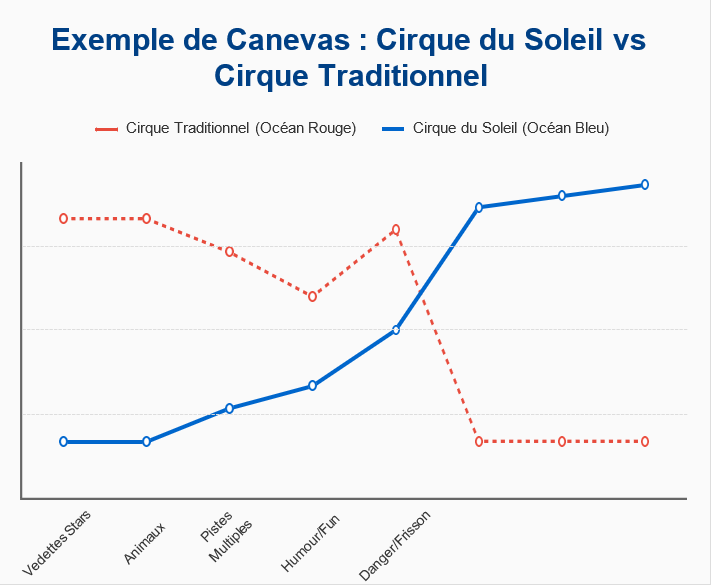
Exercise: Draw your own canvas in 3 steps
- Identify the key factors: List 5 to 10 elements that all your competitors are fighting over (e.g., price, speed, after-sales service quality, choice, etc.).
- Rate the competition: On a scale of 1 to 10, where do the market leaders stand for each factor? Connect the dots (Red Curve).
- Draw your Blue Ocean: Apply the ERRC grid.
- Which factors can you eliminate?
- Which ones can you drastically reduce?
- Which ones should you increase well above the norm?
- What new factors can you create?
Self-assessment: Are you trapped in the Red Ocean?
This quick questionnaire will help you assess the urgency of pivoting to a Blue Ocean strategy.
Check the statements that correspond to your current situation:
| □ | Your profit margins are decreasing or stagnating year after year. |
| □ | Your main selling point (or the one that customers remember) is price. |
| □ | Your customers systematically compare your offers with three or four direct competitors. |
| □ | You spend more time “putting out fires” and defending your market share than innovating. |
| □ | Your sales teams complain that “the market is tough” and lack motivation. |
| □ | You feel like you're working twice as hard to earn the same (or less). |
| □ | Your products/services are becoming increasingly similar to those of your competitors (commoditization). |
| □ | Innovation is often put on hold due to lack of budget or time. |
| □ | Customer loyalty is low: they leave as soon as they find cheaper alternatives elsewhere. |
| □ | You feel stuck: reducing costs degrades quality, but raising prices drives customers away. |
Results: Interpretation
|
🟢 0 to 3 checked You already have good differentiation. Keep widening the gap. |
🟠 4 to 6 checked Purple Ocean You are sailing between two waters. There is a real risk of slipping into mediocrity. |
🔴 7+ checked Deep Red Ocean Red alert. Your current model is in danger. Urgent action is needed. |
Ready to create your Blue Ocean?
If your self-assessment reveals that you are in the red or orange zone, don't remain passive. The Blue Ocean strategy is not reserved for giants like Tesla. It is accessible to any Quebec SME ready to challenge the status quo.
Blue Ocean Strategy: innovating to create a market without competitors
What you will learn:
- How to apply the ERRC grid to your SME in a practical way
- Identify the “non-customers” who represent your greatest growth potential
- Build a divergent value curve to make competition irrelevant
Test your new strategy at low cost before launching