


The Myth of Constant Adaptation
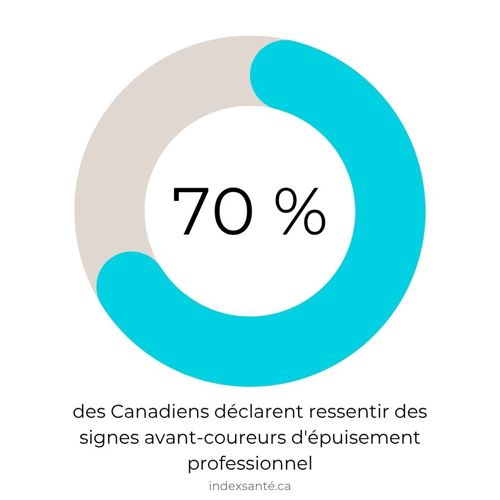
It’s tempting to believe that the solution lies in individuals’ agility. Yet in Canada, 70% of employees suffer from chronic stress.¹ This figure highlights a problem with how work is designed, and it’s a sign that the system itself is failing.
When an organization imposes a constant “sprint” pace without ever providing room for recovery or clarity on priorities, stress becomes chronic.
Adding technological tools does not solve the problem of overload. Although AI automates tasks, it also creates a new cognitive burden: that of discernment and coordination, which managers sometimes underestimate. Talented employees burn out because their work environment no longer allows them to draw on their “core” skills: they are forced to act as system verifiers, which, on the one hand, reinforces their sense of a loss of personal capability; on the other hand, makes them responsible for work carried out by a third party (AI, in this case).
To perform effectively and sustainably, we must stop confusing resilience with organizational health.
Resilience is an individual’s ability to weather challenges; it is not a management strategy, as this risks causing burnout.
Organizational health is, in a sense, the quality of the environment in which individuals work. It is also a shared responsibility: it is up to the organization to create the best possible conditions, and up to the employee to recognize their own warning signs and address them accordingly.
Sustainable performance must be the logical outcome of an environment where work is designed to support, not exhaust, the capabilities of those who perform it.
Redefining Competence in the Face of Automation

AI does not eliminate intellectual work, it shifts it. Where an employee once performed a task from start to finish, they must now take on a three-step coordinating role:
- formulating precise instructions (prompting) to obtain a usable result,
- scrutinizing the deliverables to detect errors, approximations, and hallucinations,
- and then refining the result to ensure its overall consistency.
This requires a different set of skills, which most organizations have not yet formalized or supported.
Even before rethinking processes, the preliminary question is: what can we eliminate? Automating a useless task speeds it up… it doesn’t solve it. The sequence that preserves teams’ cognitive energy is: eliminate first, simplify next, and automate last.
This is where the manager’s role becomes crucial. The challenge is to create the conditions under which the team can apply this new way of working without unnecessary overload. This requires three adjustments:
- Clarify the new expectations: if the expected deliverables have changed due to automation, state this explicitly, don’t assume the team will “adapt naturally.”
- Protect time for discernment: Verifying and refining what AI produces is not wasted time, it is valuable time. Scheduling and acknowledging this time helps prevent silent overload.
- Redistribute, don’t add to the burden: Automation should eliminate tasks that do not add value; it should not serve as a pretext for increasing the total volume of demands.
This is all the more urgent given that some competency frameworks still value multitasking—a concept that cognitive research has, however, debunked. Multitasking does not improve performance: it fragments attention and amplifies overload. Redefining practical skills also means revising these outdated paradigms.
Teams that perform well over the long term are those where the work structure and trust (in one’s own skills, in one’s manager, and in the collective project), enable everyone to give their all without getting bogged down in operational complexity. Managers who recognize this reality now regain control of their schedules; those who wait risk having to do so under urgent circumstances, pressured by costly staff turnover or a complaint filed with the CNESST.
Act Before a Crisis Strikes: Audits as a Diagnostic Tool for Survival

Law 27 requires you to prevent and anticipate problems.
To avoid the costs associated with complaints to the CNESST or absenteeism, the simplest solution is to stop guessing what’s wrong. An audit helps align the two responsibilities we mentioned above: that of the individual, who must “report the pebble in the shoe,” and that of the organization, which must ensure it is removed.
The practices that make a difference aren’t always spectacular: a regular meeting that begins with “How are you doing?” before getting down to business; goals that are co-created rather than imposed; structured opportunities for listening so that teams can express their limitations without fear of being perceived as failing. The audit helps identify which of these practices are missing, fragile, or in need of strengthening in your context.
The audit is a management tool that transforms your legal obligations into a game plan:
- Demystifying pain points: We collect real-world data from your teams to understand your culture and breaking points, using the INSPQ framework.
- Co-creating action plans: Based on the facts, we work with you to build a prioritized roadmap. Whether it’s coaching, training, or revising management practices, we tailor solutions to your budgetary and operational realities.
- Sustaining results: One year later, we measure the impact to provide you with an assessment of your return on human investment.
Take 30 minutes with one of our consultants to assess your risk exposure, with no obligation. ➡️ Exploratory call
(1) Source: Index Santé